
What Actually Matters When Buying Car Mats: An Australian Buyer’s Guide

Car mats are one of those purchases that look simple until you have to choose one. Search for “car mats” online, and you’ll find pages of products that all claim to be the best, in materials that range from carpet to rubber to something called “coil,” at prices that vary fivefold for what looks like the same thing.
The result for most buyers is the wrong mat for their car. It slides under the brake pedal. It leaves the edges of the floor exposed. It doesn’t survive the school run. Or it just looks like an aftermarket bolt-on rather than something the vehicle came with. A few years later it gets tossed and replaced, and the cycle starts over.
This is a guide to skipping that. Below are the things that actually matter when you’re choosing car mats for an Australian vehicle, in roughly the order they should drive your decision.
1. Fit is the first thing to get right
Universal car mats are made to fit nothing in particular. They are cut to a rough average size with the assumption that the buyer will trim them if needed. They cover most of the floor, slide around because they’re not anchored to the vehicle, and almost always leave the side margins of the footwell exposed.
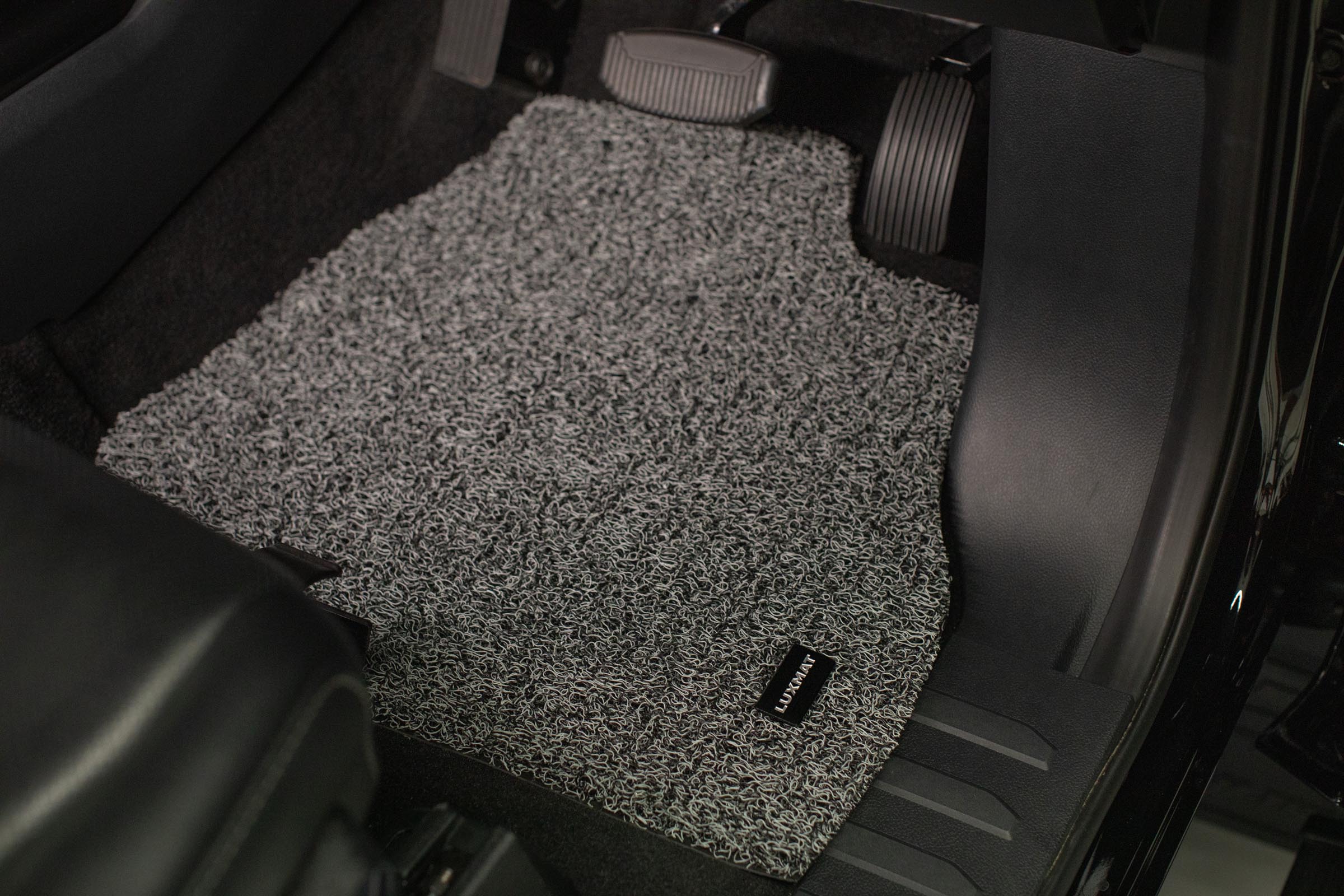
Custom-fit mats are cut to a specific vehicle’s floor pan. They follow the contours, fit into the side wells, and lock into the original anchor points. The difference matters in three ways:
- Safety. A mat that doesn’t lock into anchor points will eventually slide. If it slides toward the pedals, it changes how the vehicle drives. Australian Design Rules and vehicle owner manuals warn against this for a reason.
- Coverage. The areas universal mats miss – around the seat rails, under the dash, along the door sills – are exactly the areas that collect the most dirt and water on an Australian commute.
- Appearance. A custom-fit mat sits flush with the OEM trim. A universal one looks like a sheet of material laid on top of the floor.
If you’ve already chosen a make and model, the LUXMAT vehicle finder will tell you whether a custom pattern exists for your car. If you want to compare what’s available across the range, the browse-all-vehicles page lists every supported fitment.
2. Material drives how the mat performs
The three materials you’ll most commonly see are carpet, flat rubber, and coil rubber. They are not interchangeable. Each suits a different priority.
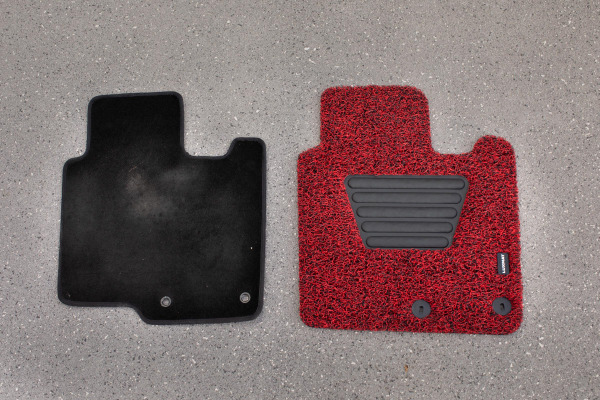
Carpet is the soft option. It feels premium underfoot and matches the cabin trim of most vehicles. It also stains, soaks up moisture, retains dirt below the surface where the vacuum cannot reach, and tends to flatten after a year or two of use. It’s best for vehicles that are kept clean, are driven by adults only, and live somewhere dry.
Flat rubber is the cheap option. It’s impervious to water, easy to wipe clean, and very forgiving. It also looks like flat rubber. The surface holds dust and grit on top rather than channelling it away from your feet, the edges are usually unfinished, and the texture rarely matches the rest of the interior.
Coil rubber is the workhorse. The looped structure creates a layered surface: debris and water fall through the loops to the base of the mat, where they stay until the mat is removed for cleaning. The top layer stays drier and cleaner than any other format. The visual finish is more refined than flat rubber. It’s the format Australian premium manufacturers, including LUXMAT, have moved toward for this reason.
A quick comparison of the three:
| Property | Carpet | Flat rubber | Coil rubber |
|---|---|---|---|
| Water resistance | Low | High | High |
| Visible dirt management | Poor | Medium | High |
| Cleaning effort | High | Low | Low |
| Long-term appearance | Flattens over time | Stays flat | Retains structure |
| Match to OEM trim | High | Low | Medium to high |
3. Build quality is in the details
Two custom-fit coil rubber mats can look identical in a product photo and behave nothing like each other in your car. The quality signals worth checking before buying are:
- Anchor system. Does the mat use the vehicle’s original anchor points? Brands that ignore the anchors save money on tooling but produce a mat that drifts.
- Edge finish. A clean, finished edge is the difference between a precision-made product and a die-cut sheet. Look for a defined border around the mat in product photography, ideally one that contrasts with the body of the mat.
- Backing. The underside should be a textured anti-slip layer, not bare rubber. The textured backing grips the OEM carpet and prevents the mat from creeping forward over months of use.
- Pattern accuracy. Patterns are produced one of two ways. The cheaper way is to trace a generic outline. The proper way is to 3D CAD-scan the vehicle’s floor and cut from the scan. The second method is the only way a mat will fit consistently across model years and trim variants.
- OEM-grade. This phrase is overused, but the meaningful version of it is: the mat is produced to the same tolerances and material standards as the mats supplied to vehicle manufacturers from the factory. It’s the difference between a part that came with the car and a part that was added to it.
4. Australian conditions are not optional
Mats sold globally are often specified for European or North American conditions. Australian summers are hotter, the UV is harsher, the off-bitumen environment is rougher, and the rain is heavier in shorter bursts. Confirm these features before buying:
- UV-stabilised material. Mats that are not UV-stable will fade and harden within a single summer of sun exposure through the windows.
- Temperature range. A mat that becomes brittle at 5 degrees or tacky at 50 degrees won’t survive a normal year in most of Australia.
- Sand, mud and water management. This is where coil rubber earns its place. The coil structure traps sand and mud beneath the surface rather than holding it on top where it grinds against the floor and your shoes.
5. Cleaning should be effortless
If a mat needs special products to clean, you won’t clean it as often as you should. The right test is whether the routine cleaning method is remove, rinse, dry. Coil rubber mats meet this standard. So do flat rubber mats. Carpet mats do not.
For coil rubber specifically, the open-loop structure allows water to drain through the surface during a hose-down rather than puddling on top. The mat dries in the sun and goes back in the vehicle the same day.
6. Cost is what you pay; longevity is what you get
The cheapest universal carpet mat is around $40 a set. A premium custom-fit coil rubber set is several times that. The right comparison is not the headline price but the cost per year of useful life:
- A cheap universal carpet mat that needs replacing in 18 months because it has stained, flattened, or torn costs more per year than a coil rubber mat that lasts a decade.
- A cheap universal mat that slides under the brake pedal has a cost that isn’t measured in dollars at all.
The mats worth buying are the ones you won’t need to think about again for years.
7. A 9-point pre-purchase checklist
Before clicking buy, work through these questions:
- Is the mat custom-fit to my specific make, model and year-range, not a universal size?
- Does it lock into my vehicle’s original anchor points?
- What is the material? If rubber, is it coil rubber or flat?
- Are the patterns produced from 3D scans of the vehicle, not generic templates?
- Is the edge of the mat finished cleanly?
- Does the backing have a textured anti-slip layer?
- Is the material UV-stabilised and rated for Australian temperatures?
- Can I clean it by rinsing with water and air-drying?
- Is it made in Australia, or shipped from offshore? Local production tends to mean local support if there is a fitment issue.
If the answer to all nine is yes, you’re buying a mat that will outlast the vehicle.
Where LUXMAT sits
Every LUXMAT mat is custom-fit, coil rubber, produced from a 3D CAD scan of the specific vehicle’s floor pan, cut on CAD-operated cutting equipment at our facility in Campbellfield, Victoria, and finished with a defined edge and anti-slip backing. The full process is detailed on the About Ultimate Auto Co. page, and the FAQ section covers everything from fitment to care.
If you already know your vehicle, the LUXMAT vehicle finder will take you directly to your fitment.